Who is Pinchord for?
In the Lost room of the Loft, Created June 10, 2026 through September 12, 2026. Also called "Why Orthospelling?"
I think there exists a middle slice in the venn diagram of alternate keyboard layouts and steno theories. Many people are unsatisfied with the standard QWERTY layout for one reason or another, and want to learn a better system, where you pretty much have the choice between learning an alternate keyboard layout and a full on steno system.
Alternate keyboard layouts don't really do very much. They just shift keys around to reduce movement and improve comfort very slightly, but they leave the entire fundamental core of typing intact. To type a word, you press every single letter of that word, one-by-one, in order, as fast as you can. To improve your typing speed, you drill your fingers to be able to move them as fast as possible, and this just destroys whatever small ergonomic benefit you may have gained from moving the keys in the first place. Most people I see quantifying their typing score do tests for 30-60 seconds, which is a frankly embarrassing amount of time :p
This method of pressing keys one-by-one, in order, is just the most inefficient method of text input you could conceivably design. We have long had a much faster, much more comfortable, and much more ergonomic system in stenography. With steno, you press all the keys that "make up" a word at the same time, and the word comes out. It is literally the job of a stenographer to listen to what is being said for hours on end, and to write it verbatim, at the speed it is being spoken (which is REALLY fast :p). And steno is extremely good at this... Which is the problem.
I think it would almost be foolish to design a system to transcribe spoken word that isn't stenography as we have it today, or one step beyond it. It is really really good at what it does... Which is not what I do at all.
I write code, prose, messages, emails, website pages, edit photos, play games, etc. - Steno is not designed for my use case.
Steno is really hard, because writing what is being said at the speed of human speech for hours on end, is really hard. Steno needs all of its complexity, it needs this barrier to learning, because without it, it could not fulfill its purpose.
I think it's very common and very normal to look at hobbyist stenographers using the systems they have mastered and want that. But when you go to learn these systems, you will be warned, many times, that it is really hard. The very first thing you will be told by the textbook recommended to beginners (https://lapwing.aerick.ca/Chapter-03.html) by the hobbyist steno community is "Steno is difficult" :p
It's not uncommon to spend 6 months to several years learning steno before you can use it full time... Which is the entire point of learning a system.
This isn't some steno exposé, I think steno is awesome and you should learn it if you're interested and that time sink doesn't faze you. There's just a very large gap between keyboard layouts and stenography that should be filled by something.
I learned and used an alternate keyboard layout for years, I was unsatisfied, so I started to learn steno, and it was too hard, So I made Pinchord.
Pinchord is a chorded keyboard layout, which is meant to deliver the benefits of steno without the enormous complexity and the steep learning curve. It truly changes the way you type, rather than just shifting some keys around.
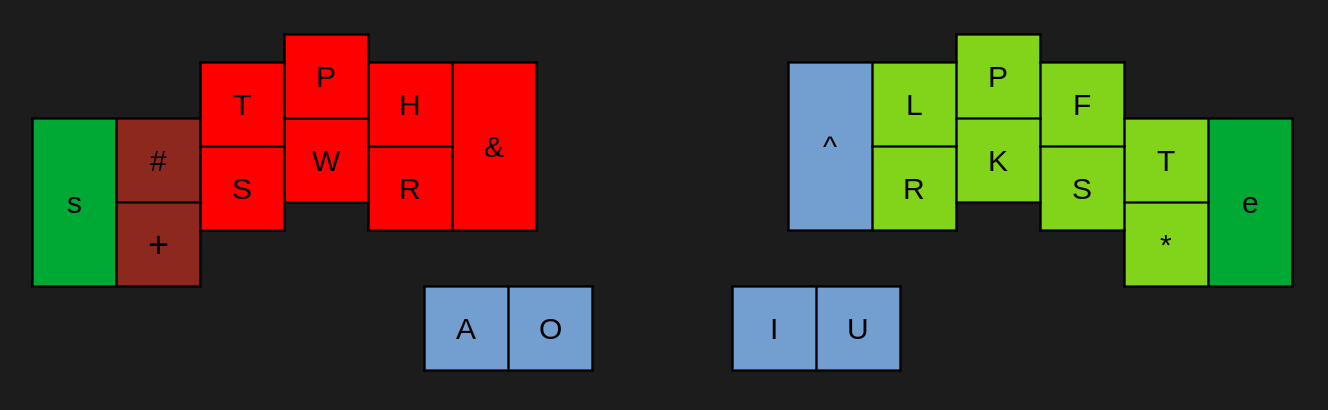
It looks like this. I won't explain the system in full, because the Pinchord already does that. But unlike steno, Pinchord has no special rules you have to learn, exceptions you have to memorize - it is just the simplest possible system that uses chords rather than keypresses.
See also Pinchord Rationale